-31-300x60.png)


Waxed corrugated boxes Australia growers, produce packers and distributors use are designed to perform in demanding refrigerated and high-humidity supply chains.
Australia’s fresh produce supply chain places significant demands on packaging. Fresh fruit and vegetables may move from regional farms and packing sheds through pre-cooling facilities, refrigerated warehouses, distribution centres, supermarkets and export terminals before reaching the final customer.
During this journey, corrugated cartons can be exposed to high humidity, refrigeration, condensation and heavy pallet stacking.
For products such as Australian table grapes, citrus, berries and vegetables, the ability of a carton to maintain its structural strength under moisture exposure can therefore be just as important as its dry compression strength.
This is one of the main applications for waxed corrugated boxes.
Wax-treated corrugated board is designed to reduce moisture penetration and help the carton retain structural integrity in wet or humid environments.
For Australian growers, produce packers, distributors and exporters, the key question is not simply whether a carton is “waterproof”, but rather:
How well will the carton perform throughout the actual cold chain?

Why Moisture Matters in Australian Produce Packaging
Standard corrugated packaging performs well in dry logistics environments.
However, corrugated board is manufactured primarily from paper fibres. When untreated fibreboard absorbs moisture, its structural properties can gradually deteriorate.
This may result in:
- carton softening;
- reduced stacking strength;
- corner deformation;
- panel bulging;
- unstable pallets;
- weakened carton bottoms; and
- possible packaging failure.
These risks become particularly relevant where fresh produce repeatedly moves between different temperatures.
For example:
Packing Shed → Pre-cooling → Cold Room → Refrigerated Truck → Distribution Centre → Retail
When a cold carton enters a warmer and more humid environment, condensation can develop on its surface.
The box does not necessarily need to be submerged in water to experience moisture-related strength loss. Prolonged high humidity and repeated condensation can also affect conventional corrugated fibreboard.
What Is a Waxed Corrugated Box?
A waxed corrugated box is a corrugated fibreboard carton treated with wax or another wax-based moisture barrier to reduce water absorption.
The objective is not simply to make the surface glossy.
The treatment is intended to help the corrugated structure maintain performance when exposed to:
- condensation;
- refrigerated storage;
- high relative humidity;
- wet produce;
- ice;
- splashing; and
- other demanding cold-chain conditions.
Different wax treatment methods can provide different levels of protection.
Wax-Coated Corrugated Boxes
With a coated carton, the moisture-resistant layer is applied mainly to the surface of the board.
This approach may be suitable for applications involving:
- condensation;
- occasional splashing;
- refrigerated storage;
- short-term moisture exposure.
Wax-Impregnated Corrugated Boxes
Wax penetrates further into the paper fibres rather than remaining primarily on the surface.
This provides additional moisture protection and can help the board retain strength under more demanding conditions.
Wax-Saturated Corrugated Boxes
Saturation treatment provides more extensive wax penetration throughout the corrugated structure.
It may be considered for packaging exposed to particularly demanding wet or high-humidity environments.
However, more wax is not automatically better.
The correct treatment should be selected according to the actual temperature, humidity, transport duration, product weight and logistics conditions.
1. Waxed Boxes for Australian Table Grapes
Table grapes are one of the most relevant agricultural applications for moisture-resistant corrugated packaging.
Victoria’s Sunraysia and Swan Hill regions are major table-grape growing areas. Agriculture Victoria identifies the typical Sunraysia grape harvest period as approximately January through May.
Once harvested, grapes require carefully controlled post-harvest handling and temperature management.
Packaging may therefore encounter:
- pre-cooling;
- high relative humidity;
- refrigerated storage;
- long-distance trucking;
- export container transport;
- substantial pallet loads;
- temperature changes during loading and unloading.
Packaging Requirements for Table Grapes
A well-designed grape carton should consider:
- moisture resistance;
- compression strength;
- ventilation;
- pallet stability;
- fruit weight;
- cold-storage duration;
- transport distance;
- handling frequency;
- custom printing and traceability.

This photograph is particularly relevant to carton engineering because it shows how produce cartons are not used independently.
They form part of an entire palletised load system.
If the cartons at the bottom of a pallet absorb moisture and lose compression strength, the stability of the complete pallet can be affected.
For this reason, evaluating wet strength and stacking performance together is important when designing cartons for refrigerated produce logistics.
2. Waxed Corrugated Boxes for Australian Citrus
Citrus is another major Australian horticultural category.
The Australian citrus sector recently reached a record farmgate value exceeding A$1.2 billion.
Oranges, mandarins, lemons and other citrus fruit may travel through refrigerated domestic distribution networks or export supply chains.
During these processes, corrugated packaging must withstand not only the weight of the fruit but also environmental moisture.
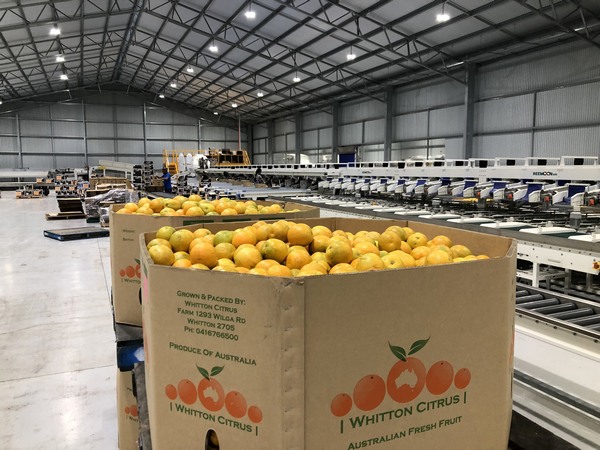
Australian citrus inside corrugated bulk packaging at a commercial packing facility. Image source: FreshPlaza / Whitton Citrus.
Typical citrus carton design considerations include:
- strong corrugated construction;
- ventilation openings;
- moisture-resistant treatment;
- stacking strength;
- handling holes;
- pallet compatibility;
- variety identification;
- grower branding;
- traceability information.
For longer refrigerated distribution routes, moisture-resistant corrugated board can help reduce the risk of carton softening.
3. Berries and Cherries
Berries and cherries are high-value produce categories that rely heavily on effective post-harvest handling.
They are often transported in smaller retail punnets or containers, with multiple consumer packs placed inside a larger corrugated master carton.
In this situation, the outer carton performs several important functions:
- protecting the retail packs;
- supporting pallet stacking;
- allowing ventilation;
- resisting humidity;
- facilitating cold-chain handling.
The packaging challenge is therefore different from simply putting fruit into a box.
The carton must function as part of a temperature-controlled logistics system.
For high-humidity distribution environments, moisture-resistant outer cartons may help maintain structural integrity over longer storage and transportation periods.
4. Vegetables and Leafy Produce
Fresh vegetables can create particularly challenging conditions for fibre-based packaging.
Depending on the commodity and post-harvest process, cartons may be exposed to:
- moisture remaining on freshly harvested produce;
- high relative humidity;
- pre-cooling;
- refrigerated rooms;
- water in processing environments;
- condensation;
- repeated handling.
Vegetable production is widespread across Australia’s major horticultural regions, including Sunraysia and southern Victoria.
For produce that enters a demanding refrigerated supply chain, waxed or other moisture-resistant corrugated packaging may therefore provide an advantage over untreated board.

Standard Corrugated vs Waxed Corrugated Boxes
| Packaging Requirement | Standard Corrugated | Waxed Corrugated |
|---|---|---|
| Dry Transport | 优秀 | 优秀 |
| Refrigerated Storage | Application dependent | Well suited |
| High Humidity | Can absorb moisture | Improved resistance |
| Condensation | Limited resistance | Better protection |
| Wet Handling | 有限公司 | More suitable |
| Long Cold-Chain Transit | Application dependent | Often advantageous |
| Pallet Stacking Under Humidity | Strength may decline | Better strength retention |
| Fresh Produce | General applications | Moisture-sensitive applications |
The important distinction is wet-strength retention.
Wax treatment cannot compensate for an incorrectly engineered carton.
Board grade, flute combination, carton geometry, ventilation holes and pallet configuration still play major roles in packaging performance.
Moisture Resistance Is Only Part of the Packaging Design
One mistake in agricultural packaging procurement is focusing exclusively on whether a carton is “waterproof”.
Commercial produce packaging also needs sufficient compression strength.
Depending on load and logistics requirements, carton construction may include:
- B flute;
- C flute;
- E flute;
- EB flute;
- BC flute;
- single-wall board;
- double-wall board;
- heavier paper grades;
- reinforced corners.
A heavy citrus carton travelling long distances may require a different board structure from a lightweight berry master carton.
For this reason, carton specifications should be developed around the entire supply chain, rather than a single material feature.
Ventilation Is Also Critical
Fresh produce continues to respire after harvesting.
Many agricultural cartons therefore incorporate ventilation openings to improve airflow and support temperature control.
Correct ventilation design can help:
- accelerate cooling;
- promote airflow;
- reduce uneven temperatures;
- improve cold-room efficiency.
However, there is a structural trade-off.
Every ventilation opening removes part of the corrugated panel.
Excessive or poorly positioned holes can therefore reduce compression strength.
For table grapes, citrus and vegetables, the ideal carton should balance:
Ventilation + Moisture Resistance + Compression Strength
rather than maximising only one characteristic.
What Should Australian Buyers Specify When Ordering Waxed Produce Boxes?
Instead of requesting simply a:
“Waxed Fruit Box”
professional buyers should provide the packaging manufacturer with practical supply-chain information.
1. Produce Type
For example:
- table grapes;
- oranges;
- mandarins;
- lemons;
- berries;
- cherries;
- broccoli;
- leafy vegetables;
- other fresh produce.
2. Carton Dimensions
Provide internal dimensions:
Length × Width × Height
3. Packed Weight
The gross weight per carton significantly affects the required board construction and compression strength.
4. Storage Temperature
Specify whether the carton will be used under:
- ambient;
- chilled;
- refrigerated;
- frozen;
- high-humidity conditions.
5. Moisture Exposure
Consider whether cartons may experience:
- condensation;
- wet produce;
- ice;
- splashing;
- prolonged humidity.
6. Pallet Configuration
Provide:
- boxes per layer;
- number of layers;
- pallet height;
- total pallet weight.
7. Transport Distance
Domestic transport lasting several hours can require a very different carton from extended refrigerated export logistics.
Food Packaging Requirements in Australia
Food-contact suitability is another important consideration.
Food Standards Australia New Zealand states that food businesses must use packaging materials that are fit for their intended purpose, are not likely to cause food contamination and do not create a contamination risk during the packaging process.
Therefore, buyers sourcing corrugated packaging for Australian food applications should evaluate whether the paper, coatings, inks and other materials are appropriate for the intended use.
This becomes particularly important when unpackaged fruit or vegetables may come into direct contact with the carton.
Are Waxed Cartons Always the Best Option?
No.
This distinction improves both purchasing decisions and technical credibility.
If produce remains relatively dry and experiences only limited moisture exposure, conventional corrugated packaging may be sufficient.
Other water-resistant coating technologies can also be considered.
Wax treatment becomes especially relevant when three factors occur together:
Moisture + Cold Chain + Stacking Loads
Australian buyers should therefore evaluate:
- humidity;
- direct moisture exposure;
- storage temperature;
- transit duration;
- carton weight;
- pallet height;
- ventilation requirements;
- food-contact requirements;
- end-of-life requirements.
The objective is not to specify the maximum possible amount of wax.
The objective is to obtain enough moisture resistance to maintain carton performance throughout the intended logistics environment.
What About Recycling Waxed Corrugated Boxes?
Traditional wax-coated corrugated packaging should not automatically be treated as equivalent to ordinary OCC corrugated cardboard.
Recycling compatibility can depend on:
- coating chemistry;
- quantity of coating;
- local recycling facilities;
- paper mill requirements;
- local collection policies.
Australian businesses with specific sustainability or recycling objectives should therefore confirm local recycling requirements when specifying coated corrugated packaging.
Where recyclability is the dominant requirement and moisture exposure is moderate, alternative moisture-resistant barrier coatings may also be worth evaluating.
Explore our custom corrugated box solutions