-31-300x60.png)


Corrugated board grade is not defined by one number alone. It is determined by a combination of liner paper, corrugating medium, flute profile, paper weight, wall construction and tested strength.
For packaging buyers, understanding these elements is essential. Two cartons may look almost identical but perform very differently during pallet stacking, refrigerated storage, export shipping or automated packing.
This guide explains how corrugated board grades work, how flute types differ, what 3-ply, 5-ply and 7-ply mean, and how to select an appropriate board structure for your product.
Quick Answer: What Is a Corrugated Board Grade?
A corrugated board grade describes the material specification used to manufacture a corrugated sheet or box.
A complete board specification may include:
- Outer liner material and paper weight
- Inner liner material and paper weight
- Corrugating medium grade
- Flute profile
- Single-wall, double-wall or triple-wall construction
- Edge Crush Test, or ECT, value
- Burst strength
- Finished Box Compression Test, or BCT, requirement
- Moisture-resistant, waxed or other functional treatment
This means that descriptions such as “B-flute box” or “five-ply carton” provide only part of the information required to evaluate packaging performance.
What Is Corrugated Board?
Corrugated board consists of flat paper liners bonded to a shaped, wave-like paper medium. The curved medium creates a series of arches between the liners, helping the board resist compression, impact and bending.
A basic single-wall corrugated sheet contains:
- One outer liner
- One corrugated medium
- One inner liner
The liners provide surface strength, puncture resistance and printability. The fluted medium separates the liners and contributes cushioning, rigidity and edgewise compression strength.
Corrugated board is also called corrugated fiberboard or corrugated cardboard. In technical packaging specifications, “corrugated fiberboard” or “corrugated board” is generally more precise than simply “cardboard.”
Corrugated Board Components
Outer Liner
The outer liner is the visible surface of the carton. It influences printing quality, puncture resistance, moisture exposure and overall appearance.
Common outer liner options include:
- Brown kraft liner
- White-top kraft liner
- White coated liner
- Recycled test liner
- Moisture-resistant liner
- Wax-coated or treated liner
A white or coated liner may be selected when graphics and shelf presentation are important. Kraft liner is widely used for transportation packaging where strength and a natural brown appearance are preferred.
Corrugating Medium
The corrugating medium is the paper formed into the flute profile.
Its quality affects:
- Flute formation
- Flat-crush resistance
- Edgewise compression
- Cushioning
- Board thickness
- Box stacking performance
Poorly formed or crushed flutes can reduce the structural performance of the finished board. TAPPI identifies flat-crush testing as a method of evaluating flute rigidity and detecting conditions such as crushed, leaning or poorly formed flutes.
Inner Liner
The inner liner faces the packaged product. Its specification may be adjusted according to product weight, abrasion risk, humidity and food-contact requirements.
For wet or refrigerated supply chains, the inner liner may require additional moisture resistance. For industrial products, a heavier inner liner may be used to reduce puncture or abrasion damage.
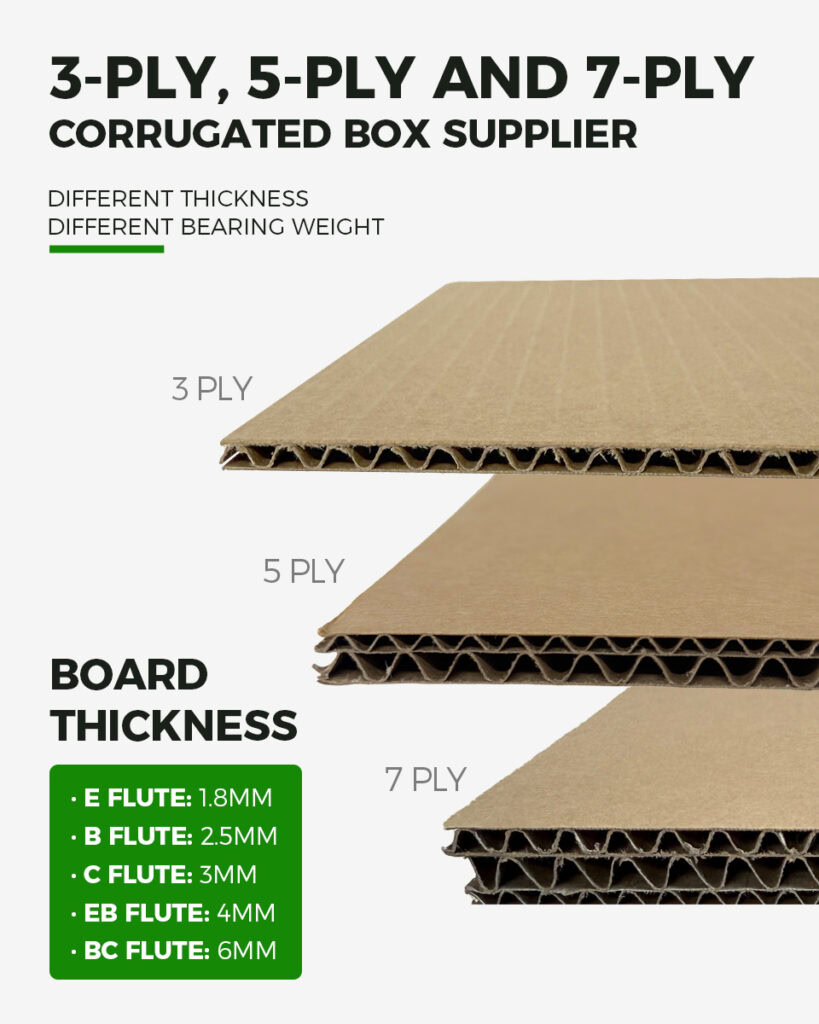
What Do 3-Ply, 5-Ply and 7-Ply Mean?
The terms 3-ply, 5-ply and 7-ply refer to the total number of liner and medium layers in the corrugated board.
| Construction | International term | Estructura | Typical application |
|---|---|---|---|
| 3 capas | Single-wall | Two liners and one fluted medium | Retail cartons, produce boxes, e-commerce and general shipping |
| 5 capas | Double-wall | Three liners and two fluted mediums | Export cartons, heavier products and palletized shipping |
| 7 capas | Triple-wall | Four liners and three fluted mediums | Machinery, automotive parts, bulk products and demanding industrial transport |
A higher ply count does not automatically guarantee that a box is suitable for every heavy product. Paper grade, box dimensions, flute combination, joint design, humidity and stacking conditions must also be considered.
SC Pack Box manufactures customizable 3-ply, 5-ply and 7-ply corrugated carton structures for different shipping and storage requirements.
Corrugated Flute Types
A flute profile describes the size, height and frequency of the waves inside corrugated board.
Smaller flutes normally provide a smoother printing surface and greater flute density. Larger flutes generally provide more board thickness, cushioning and vertical separation between the liners.
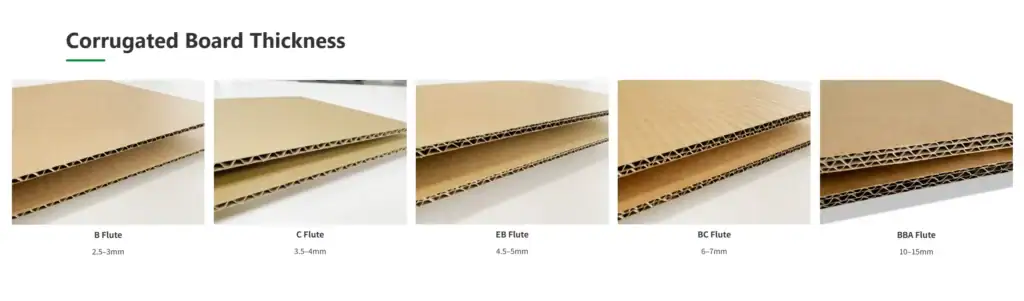
Actual thickness varies by paper combination, corrugator settings and manufacturer. The values below should therefore be treated as typical ranges rather than universal specifications.
| Flute type | Approximate board thickness | Main characteristics | Common uses |
| F flute | 0.7–1.0 mm | Very fine profile and smooth print surface | Retail packaging and small printed cartons |
| E flute | 1.2–1.8 mm | Fine flute, compact construction and good printability | Die-cut cartons, displays and smaller products |
| B flute | 2.5–3.2 mm | Good crush resistance and general-purpose performance | Produce cartons, e-commerce and standard shipping boxes |
| C flute | 3.5–4.5 mm | Greater thickness, cushioning and stacking potential | Shipping cases and medium-weight products |
| A flute | 4.5–5.0 mm | Thick profile with cushioning and vertical compression potential | Fragile products and selected transit applications |
| EB flute | 4.0–5.0 mm | Fine outer flute combined with a stronger second flute | Printed double-wall cartons and export packaging |
| BC flute | 6.0–7.0 mm | Strong double-wall construction with impact and stacking protection | Heavy products, pallet cartons and long-distance shipping |
Common converting equipment supports a broad range of profiles, including A, B, C, E, F, EB, BC and triple-wall constructions. The exact board caliper depends on material properties and the selected combination.
SC Pack Box commonly supplies E, B, C, EB and BC structures, with the final combination selected according to the product, carton dimensions and logistics environment.
Single-Wall vs Double-Wall vs Triple-Wall Corrugated Board
Single-Wall Corrugated Board
Single-wall board contains one fluted medium between two liners.
It is commonly selected for:
- Fruits and vegetables
- E-commerce shipments
- Retail products
- Lightweight food products
- General warehouse cartons
- Short- to medium-distance transport
Single-wall construction can still deliver substantial performance when strong liners, an appropriate flute and an efficient box structure are used.
Double-Wall Corrugated Board
Double-wall board contains two fluted mediums and three liners.
It is often used when the carton requires:
- Higher stacking strength
- Better puncture protection
- Increased rigidity
- Greater resistance to handling damage
- Improved performance during export shipping
EB and BC are two common double-wall combinations. EB offers a comparatively compact profile and good printability. BC provides greater thickness and is frequently selected for heavier transit packaging.
Triple-Wall Corrugated Board
Triple-wall board contains three fluted mediums and four liners.
It is designed for demanding applications such as:
- Industrial equipment
- Automotive components
- Metal parts
- Machinery
- Bulk products
- Pallet-ready export packaging
- Products that may otherwise require a wooden crate
Triple-wall cartons can provide a lighter fiber-based alternative for some industrial shipping applications. However, the complete packaging system—including the pallet, internal supports, closures and load distribution—must be engineered around the product.
SC Pack Box’s extra-hard corrugated box range is intended for industrial and high-load applications where conventional single-wall cartons may not provide adequate rigidity or stacking support.
Paper Weight and Board Grade
Paper weight is normally expressed in grams per square metre, or GSM.
A board specification may list a sequence of paper weights. For example:
200 / 150 / 200 GSM
This may indicate:
- 200 GSM outer liner
- 150 GSM corrugating medium
- 200 GSM inner liner
For double-wall board, the specification contains additional layers.
However, GSM should not be used as the only measure of packaging strength. Two papers with the same nominal weight can have different fiber composition, compression strength, moisture response and stiffness.
A technically useful corrugated specification should therefore combine paper information with relevant performance tests.
Important Corrugated Board Strength Tests
Edge Crush Test
The Edge Crush Test measures the force required to compress a sample of corrugated board while it stands on its edge.
ECT is used as an indicator of the board’s edgewise compression capability and its probable contribution to carton compression strength. It is particularly relevant to palletized boxes that must support vertical loads.
Box Compression Test
The Box Compression Test measures the compression load a completed carton can withstand before failure.
Unlike a board-only test, BCT evaluates the converted box. Its result is affected by:
- Board quality
- Box perimeter
- Carton dimensions
- Flute direction
- Score lines
- Printing and die-cutting
- Hand holes and ventilation openings
- Manufacturing quality
- Environmental humidity
TAPPI lists BCT, ECT, burst strength, puncture, flat crush and other tests as tools for predicting packaging performance and monitoring box-plant operations.
Burst Strength
Burst testing measures the pressure required to rupture or puncture a sheet of corrugated board.
It can be useful where rough handling, internal pressure or puncture resistance is a concern. However, burst strength and stacking strength are not interchangeable.
Flat Crush Test
Flat-crush testing applies force perpendicular to the board surface. It is primarily used to evaluate flute rigidity and the quality of flute formation.
It should not be treated as a direct simulation of every real-world carton load. TAPPI notes that the relationship between flat crush and field performance may be limited because the method does not fully reproduce the geometry and loading of a finished box.
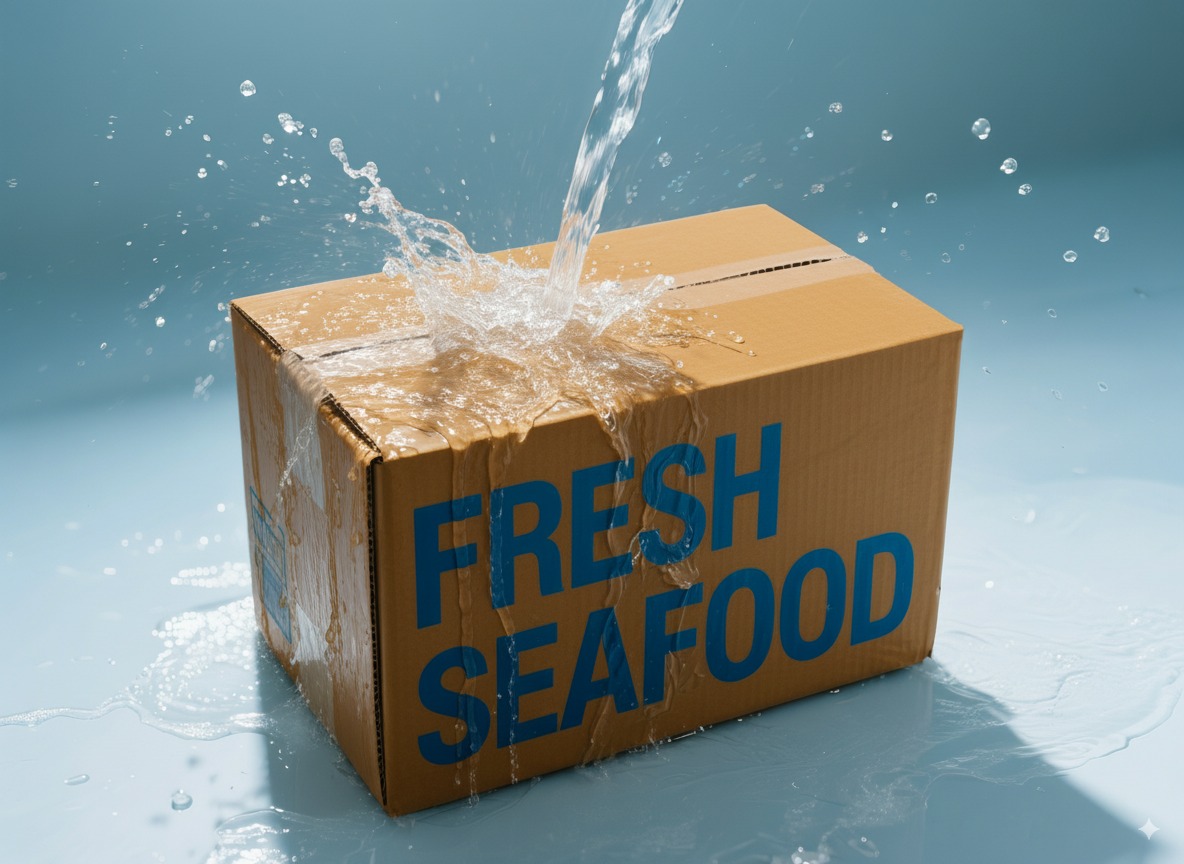
Cobb or Water-Absorption Testing
For refrigerated, produce or seafood packaging, water absorption can be as important as dry compression strength.
A board that performs well in a dry laboratory may lose strength after exposure to:
- Condensation
- Melting ice
- Refrigerated storage
- High humidity
- Wet processing areas
- Rain during loading
- Moisture from fresh produce
In these environments, the buyer should evaluate both dry and conditioned performance.
How to Select the Right Corrugated Board Grade
The correct board grade depends on the complete supply chain rather than only the weight of the product.
1. Define the Product
Record:
- Product dimensions
- Net and gross weight
- Fragilidad
- Sharp or abrasive surfaces
- Whether the load is rigid, flexible or fluid
- Whether the product supports any of the stacking load
A carton containing rigid cans behaves differently from a carton containing loose vegetables, even when both have the same gross weight.
2. Define the Logistics Environment
Consider:
- Shipping distance
- Road, sea or air transport
- Pallet configuration
- Number of cartons per layer
- Total stacking height
- Warehouse duration
- Container loading pattern
- Manual or automated handling
- Expected vibration and impact
Long export routes normally require a greater safety margin than short local deliveries.
3. Evaluate Moisture and Temperature
Ask whether the carton will encounter:
- Cold storage
- Freezing temperatures
- High humidity
- Condensation
- Ice
- Direct water exposure
- Fresh produce respiration
- Temperature changes during loading and unloading
For seafood, meat and fresh-produce supply chains, moisture exposure can reduce carton strength before the shipment reaches its destination.
SC Pack Box supplies waxed and moisture-resistant corrugated boxes designed for refrigerated logistics, seafood, meat, fruits and vegetables. These cartons can be customized according to product weight, storage conditions and transportation requirements.
4. Determine Printing Requirements
High-resolution graphics may favor:
- E flute
- Fine-flute double-wall board
- White-top liner
- Coated liner
- Lithographic lamination
- High-quality flexographic printing
Transit cartons with simple handling marks and logos may use standard kraft liners and flexographic printing.
5. Consider Box Structure
Board grade cannot compensate for a poorly designed carton.
Structural factors include:
- Regular slotted or die-cut construction
- Full-overlap flaps
- Reinforced corners
- Double-thickness end panels
- Bottom-locking design
- Hand holes
- Ventilation openings
- Internal dividers
- Corner posts
- Pallet dimensions
Ventilation openings are important for many produce cartons, but excessive or poorly positioned openings can reduce compression strength. Hole size and placement should therefore be evaluated as part of the structural design.
Recommended Board Considerations by Application
| Application | Important conditions | Common board approach |
| E-commerce | Impact, printing and dimensional efficiency | E or B flute single-wall |
| Fresh produce | Ventilation, humidity and pallet stacking | B or C flute with suitable moisture resistance |
| Seafood and frozen food | Water, ice, condensation and cold storage | Waxed or treated board, often reinforced according to load |
| Moving and warehouse storage | Repeated handling and variable loads | B, C or double-wall board |
| Embalaje para exportación | Long transit, pallet stacking and container humidity | Double-wall EB or BC |
| Industrial components | High weight, puncture and compression | Heavy double-wall or triple-wall |
| Temperature-sensitive food | Thermal control and cold-chain duration | Insulated corrugated shipping system |
This table is a starting point rather than a final engineering specification. Carton size, weight distribution and real logistics conditions must still be assessed.
Corrugated Packaging for Fresh Produce
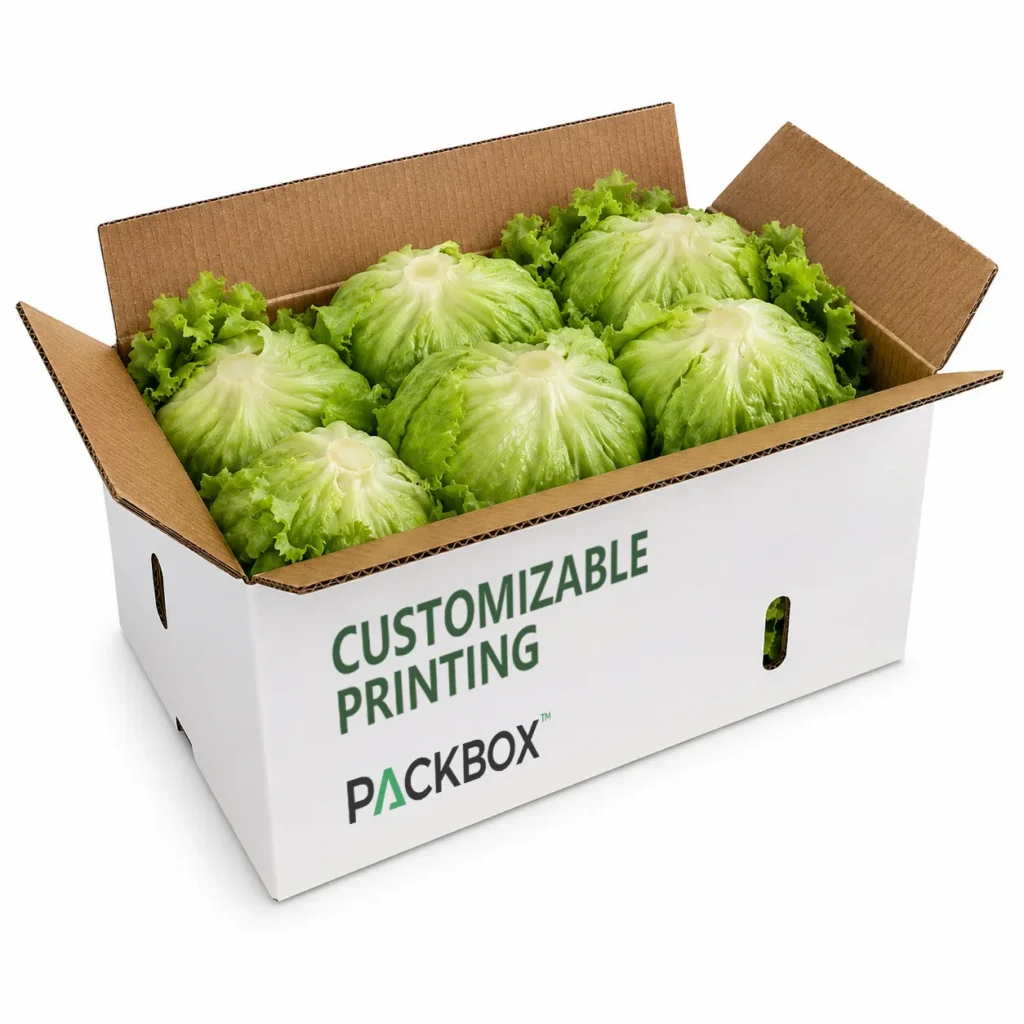
Produce packaging must protect the product while supporting airflow, cooling and pallet stability.
Important design factors include:
- Ventilation pattern
- Produce weight
- Moisture level
- Cooling method
- Pallet stacking height
- Farm and packing-house handling
- Export duration
- Retail display requirements
Leafy vegetables, berries, tomatoes, potatoes and citrus products do not necessarily require the same board or structural design.
SC Pack Box manufactures customizable fruit and vegetable packaging boxes with ventilation, moisture-resistant options, custom printing and structures for farms, growers, packing houses, distributors and exporters.
Recommended internal link: Fruit and Vegetable Packaging Boxes
Corrugated Packaging for Seafood and Cold Chain Logistics
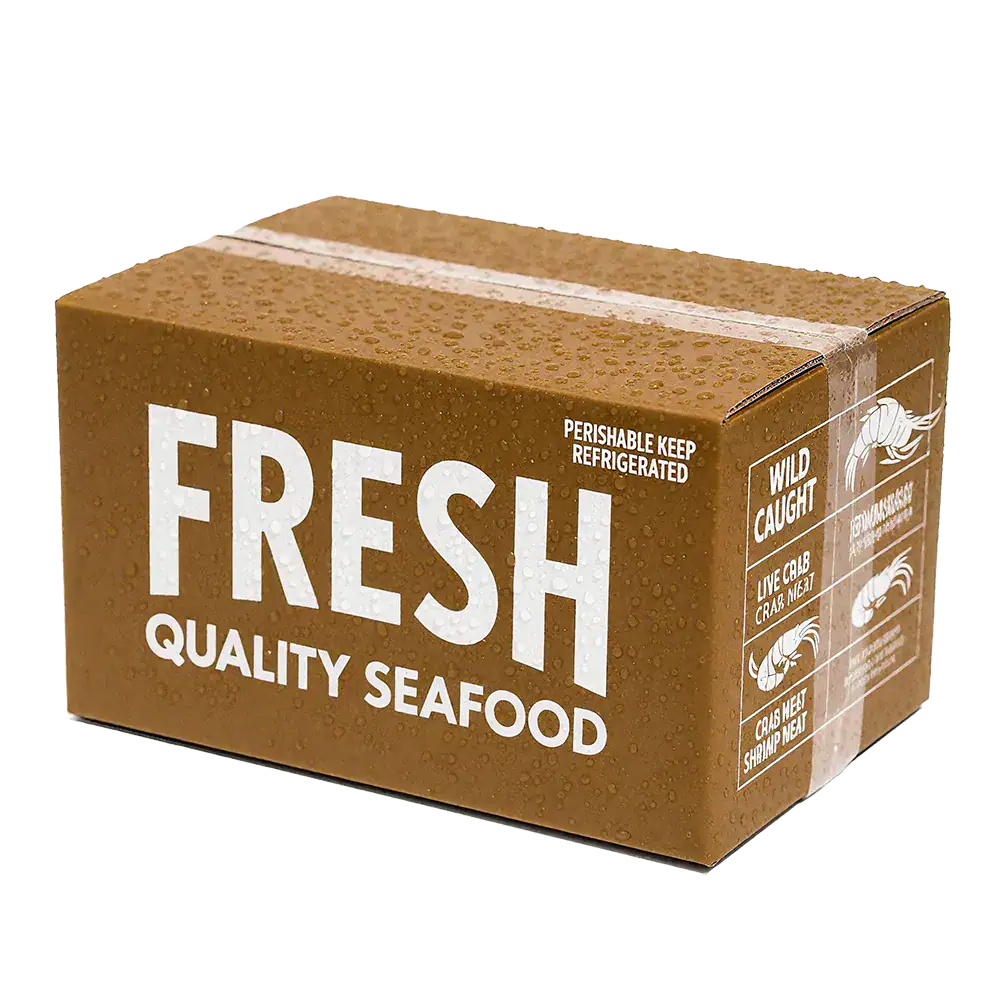
Seafood and frozen-food cartons operate in a more demanding moisture environment than standard dry-goods boxes.
A suitable specification may require:
- Water- or moisture-resistant treatment
- Improved wet stacking performance
- Stronger liner and medium combinations
- Leak-management features
- Reinforced corners or panels
- Cold-resistant adhesive
- Appropriate closure method
Wax coating or other barrier treatments should be chosen according to the required water exposure, food-contact conditions, recycling objectives and destination-market requirements.
SC Pack Box offers custom waxed corrugated cartons for frozen seafood, meat, produce and refrigerated transportation.
Recommended internal link: Cajas de cartón encerado
For products requiring temperature control rather than only moisture resistance, an insulated packaging system may be more appropriate. SC Pack Box also supplies foil-lined foam shipping boxes for cold-chain applications.
Recommended internal link: Foil-Lined Foam Shipping Boxes
Corrugated Packaging for Heavy Industrial Products

Heavy industrial packaging requires more than simply adding paper weight.
The supplier should assess:
- Load concentration
- Product center of gravity
- Dynamic handling forces
- Pallet support
- Container stacking
- Internal bracing
- Forklift handling
- Puncture risk
- Carton deflection
- Required safety factor
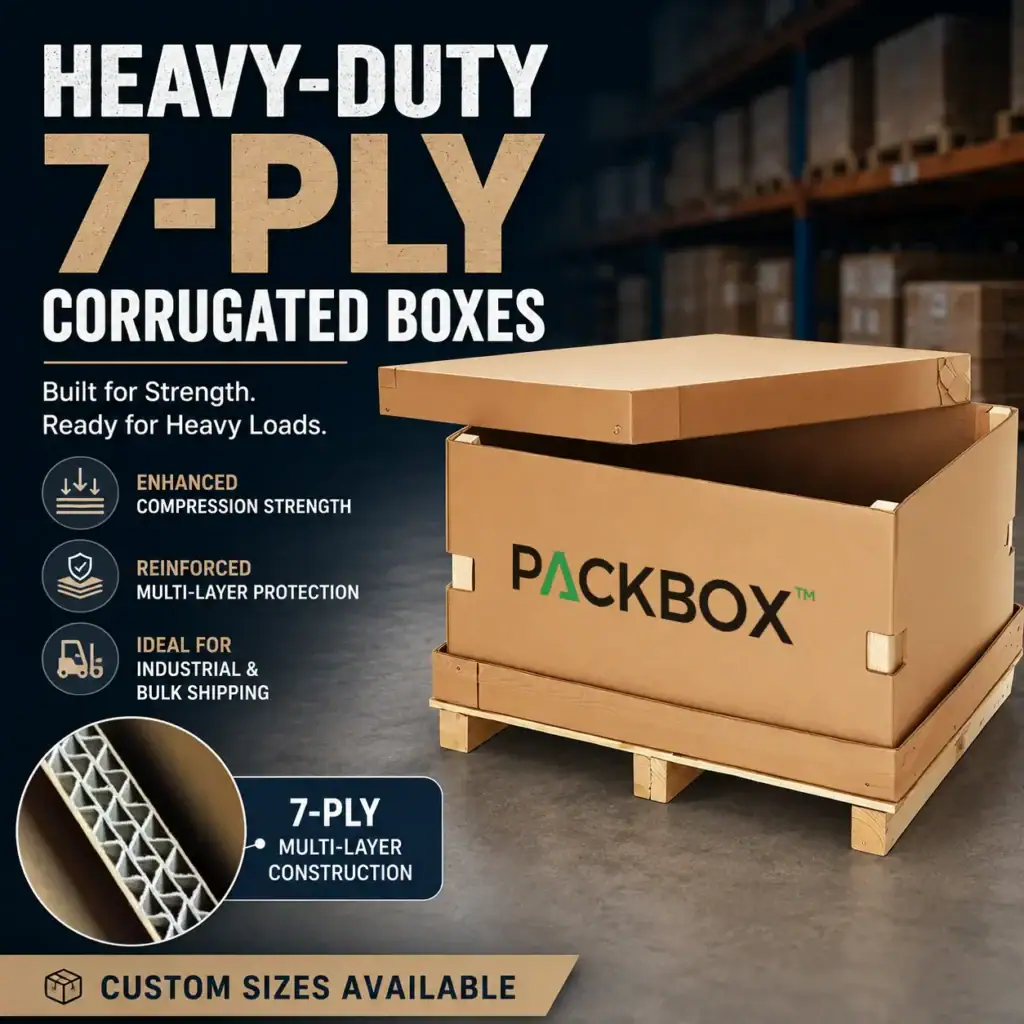
A double-wall BC carton may be appropriate for some heavy products, while other products may require triple-wall board, internal supports or a hybrid corrugated-and-wood system.
SC Pack Box provides heavy-duty and extra-hard corrugated structures that can be customized for machinery, automotive parts, bulk goods and palletized export shipments.
Recommended internal link: Cajas de cartón ondulado extra duro
Common Corrugated Board Selection Mistakes
Selecting by Ply Count Alone
A five-ply carton is not automatically stronger than every three-ply carton. Paper quality, flute profile and box design may produce significantly different results.
Comparing Only GSM
Paper weight does not fully describe compression, stiffness, puncture resistance or moisture performance.
Ignoring Carton Dimensions
A larger carton may require a stronger specification than a smaller carton carrying the same total weight because panel dimensions affect buckling and compression.
Using Dry Test Results for Wet Supply Chains
Cold-chain cartons should be assessed under representative temperature and humidity conditions.
Removing Too Much Board for Ventilation
Ventilation can support produce cooling, but openings also remove load-bearing material.
Failing to Test a Complete Pallet
Individual carton tests do not reproduce every pallet, container or warehouse condition. Whenever practical, conduct a trial using the actual product, pallet pattern and transport route.
Corrugated Board and Responsible Sourcing
Corrugated packaging can contain virgin fiber, recycled fiber or a combination of both.
When responsible sourcing claims are important, buyers may request documentation such as FSC Chain of Custody certification. FSC explains that Chain of Custody certification applies to organizations that manufacture or trade forest-based products and supports traceability and controlled use of FSC claims.
However, buyers should distinguish between:
- Recyclable packaging
- Packaging containing recycled fiber
- FSC-certified material
- FSC Mix material
- FSC Recycled material
- Compostable materials
- Moisture-resistant or barrier-treated materials
These terms describe different attributes and should not be used interchangeably.
Functional coatings may also affect local recycling acceptance. Packaging buyers should confirm recovery requirements in the destination market, particularly for heavily waxed, laminated or multi-material packaging.
How SC Pack Box Develops a Corrugated Box Specification
A practical custom-packaging process should begin with operating conditions rather than a predetermined flute.
SC Pack Box recommends providing the following information:
- Product type
- Internal box dimensions
- Gross weight per carton
- Number of cartons per pallet
- Pallet stacking height
- Transportation method
- Storage temperature
- Moisture or water exposure
- Required printing
- Order quantity
- Destination market
- Current packaging problem
Based on these details, the board grade, flute combination, box structure, coating and printing process can be evaluated together.
SC Pack Box is a China-based corrugated carton manufacturer established in 1997. Its product range includes waxed cardboard boxes, fruit and vegetable cartons, moving boxes, insulated shipping boxes and heavy-duty corrugated packaging. The company also provides custom structural and printing support for export projects.
Buyer’s Corrugated Box Specification Checklist
Before requesting a quotation, prepare the following:
- Internal length × width × height
- Product name
- Net and gross weight
- Product arrangement inside the carton
- Required board construction
- Preferred flute, when known
- ECT, burst or BCT requirement
- Moisture exposure
- Storage temperature
- Ventilation requirement
- Printing colors
- Surface finish
- Handle or opening requirements
- Pallet size and stacking pattern
- Shipping destination
- Estimated annual quantity
Providing this information reduces the risk of comparing quotations based on different materials or performance assumptions.
Frequently Asked Questions
What is the most common corrugated flute?
B flute is widely used for general shipping, produce and die-cut packaging because it provides a practical balance of board thickness, crush resistance and converting performance. However, there is no single best flute for every product.
Is C flute stronger than B flute?
C flute is generally thicker and can provide greater cushioning and vertical separation between liners. Whether the finished carton is stronger depends on the paper grades, box dimensions, board construction and manufacturing quality.
What is the difference between E flute and B flute?
E flute is thinner and has more flutes per unit length, creating a smoother surface for printing and compact packaging. B flute is thicker and is commonly selected for general-purpose shipping cartons.
What is EB flute?
EB is a double-wall board combining E flute and B flute. It can provide a relatively smooth printing surface together with improved rigidity and impact protection.
What is BC flute?
BC is a double-wall board combining B and C flutes. It is commonly used for heavy products, palletized loads and export cartons requiring greater thickness and protection.
Is five-ply cardboard the same as double-wall corrugated board?
Yes. In common packaging terminology, five-ply board normally consists of three liners and two corrugated mediums, making it a double-wall construction.
Is seven-ply cardboard the same as triple-wall board?
Yes. Seven-ply board normally contains four liner layers and three fluted mediums.
Does a higher GSM always mean a stronger carton?
No. GSM describes paper weight, but carton performance also depends on fiber quality, flute formation, board construction, box dimensions, moisture and structural design.
Should I specify ECT or BCT?
ECT evaluates the edgewise compression of the board. BCT evaluates the compression strength of the completed carton. For palletized and stacked packaging, both may be useful, but BCT more directly represents the converted box.
Which corrugated board is suitable for seafood packaging?
Seafood cartons usually require moisture-resistant or waxed board, adequate wet stacking performance and a structure designed around water, ice, product weight and cold-storage conditions.
Which board is suitable for heavy machinery parts?
Heavy machinery components commonly require strong double-wall or triple-wall corrugated board, reinforced structures and internal supports. The final design should be confirmed through load and transport testing.
Can corrugated boxes be customized?
Yes. Corrugated cartons can be customized by size, flute, paper grade, wall construction, printing, coating, ventilation, handles, internal fittings and closure method.
Conclusión
Selecting a corrugated board grade is an engineering decision, not simply a choice between brown or white cardboard.
The correct specification should balance:
- Product protection
- Compression strength
- Resistencia a la humedad
- Printing quality
- Material efficiency
- Packing-line compatibility
- Logistics cost
- Destination-market requirements
For standard shipping, a single-wall B- or C-flute carton may be sufficient. Export loads may require EB or BC double-wall construction. Heavy industrial products may require triple-wall board, while seafood and fresh produce may need moisture-resistant or waxed materials.
SC Pack Box provides custom corrugated packaging solutions for produce, seafood, frozen food, warehouse, moving and heavy-duty industrial applications. Submit your product dimensions, carton weight, logistics conditions and estimated quantity to receive a board-grade and structural recommendation.